HOCl Surface Wipes Packaging and Sample Testing Checklist for Buyers
Evaluate HOCl surface wipe samples as a full pack system: intended use, compatibility, seals, moisture retention and product-specific documents.
A private-label HOCl surface wipe can look acceptable in a first sample and still fail in the places that matter: dry wipes at the bottom of the pack, a loose lid after transport, unclear storage language, or missing assay records for the filled product. For public-space surface applications, the sample review should test the whole system, not just the wipe sheet.
This checklist helps procurement, quality, and product teams evaluate HOCl surface wipes before moving from sample request to packaging approval. It focuses on public-space surfaces such as counters, touchpoints, fixtures, equipment exteriors, seating areas, and other non-porous or compatible surfaces defined by the project brief and destination market.
1. Define the intended surface use before asking for samples
Start with the exact use case. HOCl wipes intended for public-space surfaces should not be reviewed as hand wipes, baby wipes, pet wipes, or general personal-care wipes. The formulation, label language, substrate, packaging, and compliance pathway may differ.
In the sample request, describe:
- Use environment — public transit, hospitality, schools, gyms, retail spaces, shared facilities, food-service-adjacent areas, or other public settings.
- Target surfaces — list the surface types in scope, such as finished plastic, stainless steel, glass, sealed laminate, vinyl, painted surfaces, or other materials. Ask the supplier to flag surfaces that need compatibility testing.
- Out-of-scope uses — state that the wipe is for public-space surfaces only if that is the intended project. Avoid wording that suggests skin, infant, pet, wound, or medical use unless the project has been separately designed and reviewed for that category.
- Destination market — identify the United States, European Union, United Kingdom, Switzerland, or other target markets early. Labeling, allowed claims, language requirements, documentation, and packaging waste rules can vary by destination.
This first step prevents the wrong sample from entering the review process.
2. Request samples that match the proposed commercial pack
A lab-prepared wipe in a temporary pouch may help screen the concept, but it does not prove that the final pack will hold moisture, protect the formulation, or dispense well.
Ask for samples in stages:
- Screening sample — used to check wipe feel, size, wetness, odor, and basic packaging direction.
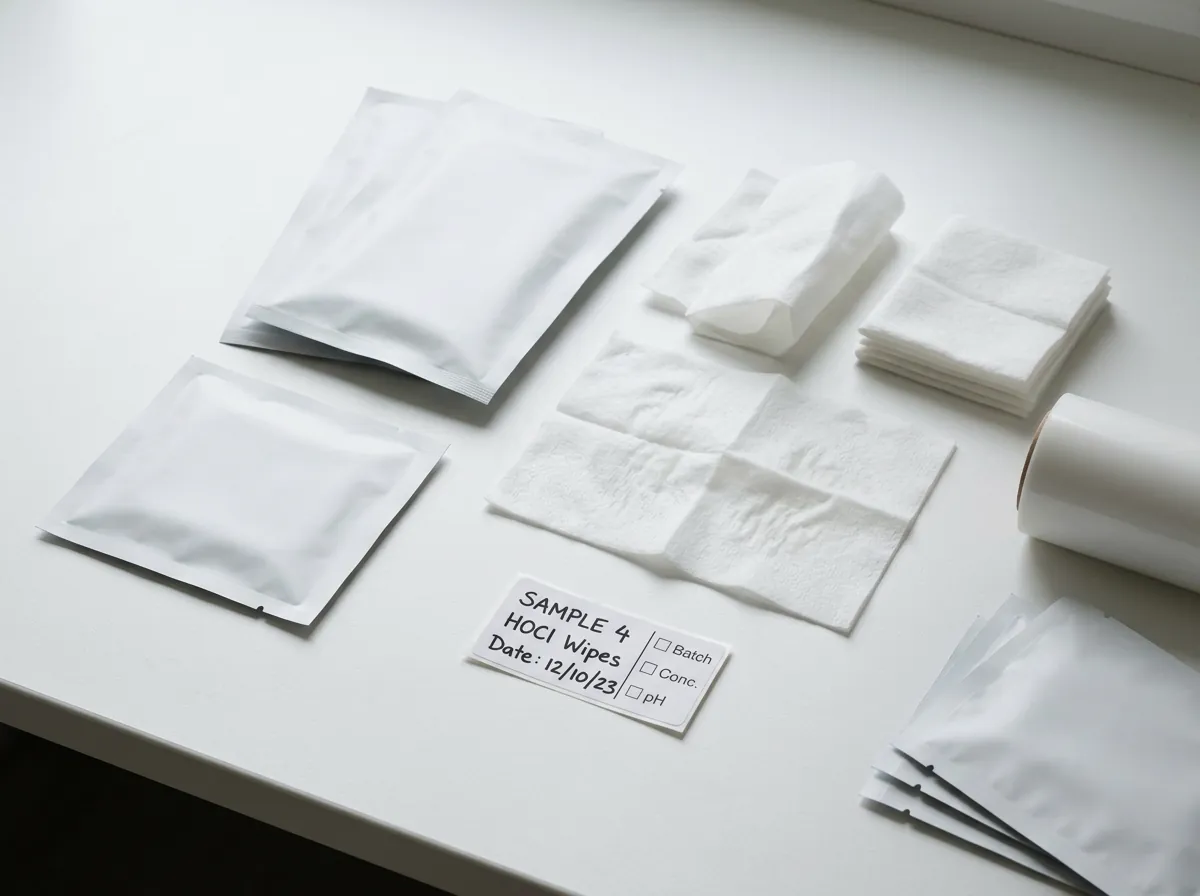
- Packaging-representative sample — made with the proposed substrate, liquid load, primary pack, closure, label material, and seal style.
- Pre-production or pilot sample — filled on the intended production equipment or a process that closely reflects commercial production.
For each sample lot, record:
- Sample name and version
- Date received
- Supplier batch or lot code
- Fill format and pack count
- Substrate description
- Packaging components used
- Documents received with the sample
- Internal reviewers and decision status
A sample without version control can create confusion later. If the project changes substrate, pack film, cap, wipe count, label stock, or liquid loading, treat it as a new sample version.
3. Check substrate and HOCl packaging compatibility
HOCl formulations can be sensitive to the materials they contact. Buyers do not need to guess whether a substrate or package is suitable. The supplier should be able to explain what has been tested and what remains unconfirmed.
Use practical questions:
- Has the proposed wipe substrate been evaluated with the intended HOCl formulation?
- Does the substrate bind, reduce, or otherwise affect the active content over time?
- Has the liquid loading been assessed across the top, middle, and bottom of the pack?
- Are the primary pack film, inner seal, closure, adhesive, and label materials compatible with the filled product?
- Are any inks, coatings, liners, or glues in contact with the liquid or exposed to vapor?
- Has the supplier reviewed headspace, package swelling, discoloration, odor change, or material brittleness during storage?
- Does the proposed package protect the product under the expected storage and distribution conditions?
Request written answers, not only verbal reassurance. For HOCl wipes, compatibility is part of the product design.
4. Test seals, closures, and moisture retention
Moisture loss is one of the most practical failure points for surface wipes. A pack that dries out after opening, leaks during transport, or dispenses poorly can lead to complaints even if the formulation was acceptable at filling.
During sample testing, check:
- Initial seal integrity — inspect the pouch, canister, tub, flow-wrap, or refill pack for leaks, weak seams, punctures, or seal channels.
- Opening experience — confirm that the consumer-facing opening method is clear and repeatable. If a peel-back label or flip-top lid is used, test whether it reseals after repeated openings.
- Moisture distribution — compare wipes from the top, middle, and bottom of the pack. Record whether they feel evenly saturated or uneven.
- Dispensing — pull multiple wipes in sequence. Watch for tearing, rope dispensing, clumping, dry edges, or difficulty starting the next wipe.
- After-opening holding — store an opened sample under the supplier’s stated conditions. Check whether the closure stays secure and the wipes remain fit for the intended review period.
- Transport stress — inspect samples after shipping. Look for crushed closures, leaking corners, label lift, weakened seals, or liquid migration.
Do not approve packaging based only on appearance. Seal quality and moisture retention should be part of the acceptance record.
5. Ask for product-specific stability and assay documents
For private-label HOCl surface wipes, documentation should match the actual filled product as closely as possible. A document for bulk liquid alone may not answer what happens after the liquid is loaded onto the substrate and sealed in the final package.
Ask the supplier which documents are available for the proposed product or nearest representative build, such as:
- Active content or assay report for the filled wipe product
- Stability data for the formulation in the proposed packaging system
- Compatibility notes for the substrate and primary package
- Microbiological or quality-control release records where applicable
- Finished-product specification
- Packaging specification
- Storage condition statement
- Lot coding and traceability method
- Safety data or transport documents appropriate to the product classification
Avoid filling gaps with assumptions. If a claim, instruction, or shelf-life statement is intended for the label, ask what data supports it and whether that data applies to the exact package under review. A supplier summary is not a substitute for current official guidance in the destination market.
6. Review storage and handling instructions as part of the sample
Storage instructions are not an afterthought. They affect warehousing, distribution, retail handling, and end-user performance.
Check whether the sample and supporting documents clearly state:
- Recommended storage conditions
- Conditions to avoid, such as heat, freezing, direct sunlight, or damaged packaging, if applicable
- Whether packs should be stored upright or flat
- Handling after opening
- Resealing instructions
- Lot code location
- Expiration or use-by format, if used and supported
- Language needs for the destination market
Keep the wording practical. If the pack relies on a lid, label, or cap to retain moisture, the instructions should tell users to close it after each use.
7. Build a sample acceptance checklist
A simple acceptance form helps procurement compare samples fairly and prevents last-minute changes from slipping through unnoticed.
| Review area | What to record |
|---|---|
| Intended use | Public-space surface use and excluded uses |
| Destination market | US, EU, UK, or other target markets |
| Surface scope | Target materials and any supplier cautions |
| Substrate | Material, basis, texture, wipe size, compatibility status |
| Formula documents | Assay, stability, and filled-product records received |
| Pack format | Pouch, canister, tub, refill, or other proposed format |
| Seal and closure | Initial seal, reseal performance, leak observations |
| Moisture retention | Top, middle, and bottom wipe condition and opened-pack review |
| Dispensing | Ease of pull, tearing, clumping, and user handling |
| Label and instructions | Storage, opening, resealing, lot code, market language |
| Decision | Approved, approved with changes, rejected, or retest needed |
Keep photos with the record. A picture of a leaking seam, lifted label, or dry wipe is often more useful than a long email thread.
8. Include the right questions in the sample request
A strong sample request saves time because it asks for the product system, not just a “wet wipe sample.”
- What exact substrate is used in this sample?
- Is the sample filled with the proposed HOCl formulation for our surface-wipe project?
- Is the pack format the intended commercial format or a temporary sample pack?
- Which components are final and which are placeholders?
- What active assay or stability data applies to this filled wipe sample?
- What storage conditions should we use during sample review?
- What surfaces has the supplier evaluated for compatibility?
- What label claims, if any, are supported by documentation for the destination market?
- Can the supplier provide packaging dielines, material specs, closure specs, and artwork requirements?
- What changes would require a new sample or new stability review?
9. Prepare the packaging handoff before approval
Once a sample is close to approval, collect the handoff files and specifications that turn the sample into a controlled order.
Request:
- Final pack dimensions and fill count
- Approved substrate specification
- Approved liquid loading target and tolerance, if established by the supplier
- Primary packaging material specification
- Closure or lid specification
- Label or artwork dielines
- Print area and required warning or instruction zones
- Lot code position and format
- Case pack and pallet information, if available
- Storage and shipping instructions
- Approved sample reference and version number
Tie every handoff file to the approved sample version. If artwork, pack material, closure, or substrate changes later, decide whether the sample needs to be reopened for testing.
Short FAQ
Are HOCl surface wipes the same as hand or baby wipes?
No. This checklist focuses on wipes for public-space surfaces. Skin, infant, pet, wound, or other personal-use products need separate product design, labeling, documentation, and compliance review.
Can a buyer approve a sample based on wipe feel alone?
No. Wipe feel is only one part of the review. The filled product, substrate, seal, closure, moisture retention, instructions, and supporting documents should be checked together.
What documents matter most for HOCl surface wipe samples?
Ask for product-specific assay or active content records, stability information for the filled wipe or closest representative product, substrate and package compatibility notes, storage instructions, and finished-product specifications.
Should public-space surface claims appear on early samples?
Only supported, reviewed claims should move toward commercial labeling. Early samples can use draft wording, but procurement should ask what documentation supports each intended claim in the destination market. Consult current official guidance for that market — for example, EPA label guidance or the European Commission overview of biocidal products where those frameworks apply. This article is not a substitute for that specialist review, and it does not establish that a product is registered, approved, or cleared.
Move forward with a controlled sample review
The best sample process for HOCl surface wipes is specific, documented, and tied to the final pack. Define the surface use, request samples that match the commercial build, test the seal and moisture retention, and collect product-specific records before approval.
For a new private-label HOCl surface wipe project, prepare a clear inquiry with the intended surfaces, destination markets, preferred pack format, expected review documents, and any packaging constraints. That gives the supplier enough detail to propose samples that can actually be evaluated.
Related reading: the wet wipes sample approval checklist, the private-label RFQ checklist, and DUNTEK’s disinfectant wipes category. To start a project discussion, use the contact form.